Financial management, Small Business Finance, Business Startup Finance and entrepreneurs finance for high tech companies - Michael Gonnerman Small Business Finance, Business Startup Finance and Venture Capital Finance for High Tech Companies - Michael Gonnerman, Inc.
Ask Mike - Answers to common questions about financial management and entrepreneurial finance for everyone.

Read "Ask Mike", an entrepreneurs' guide to questions that baffle just about everyone: from boardroom behavior to the care and feeding of the sales force to where the money comes from.

"Informative and entertaining"
-- BusinessWeek Online

"Packed with essential tips for entrepreneurs"
-- Eric Janszen, founder iTulip, Inc.

"Practical guidance ... for people getting into
startup business for the first time"

-- Gregg Fairbrothers, Adjunct Professor, Tuck

"Advice that an entrepreneur needs"
-- Peter Glenshaw, Managing Director for Venture Initiatives,
Dartmouth College


Need an experienced financial
director/advisor?

Since 1993, Mike has served on the Boards of Directors or advisors of twenty nine companies. Many of these companies have realized liquidity events, either a sale or IPO. To read more about Mike's experiences, click here.

Just fired your CFO?
Mike has consulted to more than 90 companies. He offers a full range of CFO services, from helping with financing to negotiating sales and acquisitions.

Check out Mike's page in the DEN Newsletter (Dartmouth Entrepreneurial Network).  Go to page 17.

Michael Gonnerman offers financial management and entrepreneurial finance advise for high tech companies

Mike is a financial guru. He has 42 years experience as
a Director, Advisor, financial consultant, CFO and auditor, and has helped companies deal with issues involving corporate oversight, financial management, financial reporting, forecasting and financing. His financial tools have been adopted by hundreds of companies, and he speaks frequently on finance and entrepreneurship. Click here to read some of his comments.

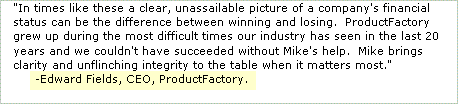
What Mike's Clients are saying
Sign up for the Ask Mike Newsletter

Ask Mike

answers to common
(and uncommon)
questions about
entrepreneurial finance

January 30, 2010 Issue #67

Why is my sales manager protecting deadbeats?

"I'm supposed to be in charge of collecting receivables, but every time I lean on a slow customer my sales manager has a fit. The CEO just says, 'Work it out somehow.' Any advice?"

Mike: Before you can solve this problem, you need to get at the root cause. The most likely explanation is that your sales manager is nervous about his team's relationships with customers. Are there problems with product quality? Are customers being encouraged to buy more than they need or can afford? Are his sales reps writing what are essentially phantom deals ("pay us whenever you feel like it")? Unhappy customers tend to pay their bills slowly, and it's possible that your sales manager doesn't want the rest of the company to hear the bad news.

However, the other possibility is that you really are being too aggressive in your collection efforts. For instance, your customers may need several months to cut a check for year-end license renewals or support contracts because the paperwork gets bogged down in purchasing and legal reviews. Rather than nag your slow-paying customers, ask them if there's anything you can do to fast-track your invoices. You might be surprised by what they tell you.

Is a two-year non-compete too long?

"A potential investor group is interested in putting money into my company, but first they want several key employees to sign two-year non-compete agreements. At most, my employees say they'll sign six-month agreements. Is there a standard term for these contracts?"

Mike: The short answer is no. You and the investor group must determine what's a reasonable time period to protect the company if your employees leave to join a competitor. Unless there's a very unusual competitive situation, a two year non-compete seems excessive. Six months is more common in my experience, and you should remember that there are some states--such as California--where non-compete agreements are rarely enforced.

If your investors won't accept six months protection, you should talk with them about other ways to persuade key employees to stick around. For instance, you might offer stock options with a minimum two-year vesting period. Or you could pay a hefty deferred retention bonus (which might have to come out of your pocket, if you want to make the deal work). However, you should also be prepared to walk away from these investors if they refuse to be flexible on this one issue. They may not be the right partners to help you grow your company.

What kind of 'overhead' can we charge?

"Is there a formal accounting definition of 'costs' for cost-plus contracts? My CEO wants me to pile on all kinds of overhead expenses that I feel are excessive, but I don't have any contrary evidence for a more conservative approach."

Mike: Typically, these rules are spelled out in the bidding process or in standard contracts, to minimize this kind of ambiguity. (For instance, most government contracts cover the cost-plus question in pretty painful detail.) I'm guessing that you're dealing with an inexperienced or lazy customer who failed to provide guidelines up front. Your problem isn't just with your CEO--you also have a potential here for a fight with the customer over getting paid for any poorly-defined overhead costs.

Your best bet at this point is to refer back to the cost calculations you presented in your original bid, which presumably the customer approved. When you send an invoice, report your overhead expenses with as much detail as possible, and describe these line items using the same language as the bid or contract. This approach should minimize disputes with both your CEO and the customer.

Is an advisory board member liable for damages?

"I'm on the advisory board of a startup, and I get paid a few dollars a year for occasional meetings and phone consultations. I know the company provides errors and omissions insurance for the regular board of directors. Is this something I should insist on?"

Mike: Even if the company implements an idea of yours that harms someone, you and your fellow advisory board members have no authority to make corporate decisions. That's something only the directors and officers of the company can do, so they're the only people with any legal or financial exposure. You're in the clear.


Copyright 2009 Michael Gonnerman, Inc. All Rights Reserved.