 |

|
 |
 Read "Ask Mike", an entrepreneurs' guide to questions that baffle just about everyone: from boardroom behavior to the care and feeding of the sales force to where the money comes from. "Informative and entertaining" "Packed with essential tips for entrepreneurs" "Practical guidance ... for people getting
into "Advice that an entrepreneur needs"

Need an experienced
financial Just fired your CFO? |

Mike is a financial guru. He has 40 years experience as 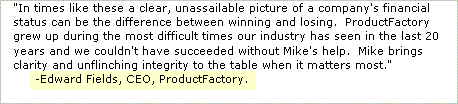

Ask Mike August 4, 2009 Issue #64 Am I at risk from claw-back rules?"We put a large customer on COD terms about a year ago, but it occurs to me that a bankruptcy judge might decide that we're getting preferential treatment and 'claw back' some of the money we were paid. Is there anything we can do to protect ourselves?" Mike: Yes. Immediately ask a bankruptcy lawyer to review the agreement you have with your customer, to limit your exposure to clawback litigation and related problems. Your situation is very risky, especially if other vendors are getting paid in 30-90 days. If your customer defaults and leaves these creditors with major losses, it's very possible a bankruptcy judge will force you to return any money you collected within 90 days of the bankruptcy. Since your customer is currently willing to pay you on COD terms, you obviously have some extra leverage in this deal right now. But this leverage will disappear in a bankruptcy filing. And remember that your exposure isn't limited to current receivables: If your customer goes bust, you'll probably have to write off materials, labor, and production capacity that you've committed to the customer's business. Finally, be sure to discuss your risk exposure with your board members, your investors, and perhaps your banker. If any of your financial stakeholders are caught by surprise, they may react by cutting off your funding just when you need extra cash. Be sure everyone is on board with how you're handling this customer. How can I get my sales reps to work in the summer?"We pay our sales reps a small draw and substantial commissions. Does that give them the right to work shorter hours whenever they feel like it? We really struggle to provide adequate sales coverage in the summer, and we lose business as a result" Mike: This is a common problem with sales reps whose pay is heavily weighted toward commissions. You don't pay your reps extra if they put in overtime for a big sale, so they probably feel entitled to hit the beach whenever business is slow. An easy way to solve this problem is simply to increase the commission
rate on any sales that close in July, August, and September. I'll bet
the increase in your summer sales volume will more than make up for the
larger commission checks you'll write. Why isn't my board more strategic?"I set up a board of directors last year to help me with big-picture issues (pricing, R&D investments, creative marketing). But so far all they do is nitpick our expenses, which I can do by myself. How can I get the board to add real value?" Mike: Remember that it takes a while for any new director to learn the fine points of your product line, your market dynamics, your people, your financial picture, and all the other nuts and bolts that affect strategy decisions. You can get your directors up to speed faster by educating them on your company's fundamentals. Take them on a company tour, ask your department heads to make presentations, introduce them to major customers, and walk them through a sales demo. Also, meet with your directors one-on-one and tell them exactly what
you want from the board. You may want directors who contribute great
insights, but I've known plenty of CEOs who prefer less-active boards
or boards whose main job is to open doors with key customers and investors.
You'll get better results if you clearly define your expectations. How should I deal with salary disparities?"My partners and I acquired controlling interest in a small publishing company whose salaries are all over the map. I'd like to set up a standardized compensation scale, but that would mean cutting or freezing the pay of many somewhat-overpaid staff members. Suggestions?" Mike: I hope you knew about this mess and factored it into the price you paid for the company, because there's no cheap or painless solution. Start by announcing that you and your partners are well aware of the salary disparities you inherited and are committed to a policy of fairness. Then announce the new salary scale and immediately bring all underpaid staff members up to the appropriate levels. Don't cut corners--if you tell an employee he's worth $20,000 more but you're only offering a $10,000 raise now, you're guaranteed to inspire more resentment than gratitude. You also have to put the overpaid people on notice that they probably
won't see raises for a long time. Some will resign (or at least will
update their resumes), and others will collect their paychecks but probably
won't contribute more than the bare minimum needed to hold their jobs.
Make it clear to the overpaid employees that you expect extra performance
from them. If they grumble, begin looking for replacements. |
 Home
Home
 answers to common
Copyright 2009 Michael Gonnerman, Inc. All Rights
Reserved. |